Leadership Through Partnership
GenCoE will be led by the Coordinating Centre hosted by Jhpiego in Kigali, Rwanda, leveraging Jhpiego's extensive in-country presence and longstanding partnership with the Ministry of Health (MOH) and Rwanda Biomedical Centre (RBC). Jhpiego's proven track record in strengthening health systems, implementing innovative public health programs, and coordinating multi-country initiatives makes it an ideal home for the GenCoE Coordinating Centre.
Why Jhpiego?
As host to the GenCoE Coordinating Centre, Jhpiego brings decades of experience in global health implementation across more than 38 countries, with a strong footprint in Africa. Its established partnerships with Ministries of Health in Rwanda, Ghana, Nigeria, and Tanzania position it to effectively align GenCoE activities with national health priorities. Jhpiego's expertise in biosafety, surveillance, and emergency response is exemplified by its training of over 34,000 community health workers in Rwanda on electronic surveillance systems. Furthermore, Jhpiego leads in health innovation, applying AI-powered tools, genomic data integration, and digital diagnostics to advance maternal and child health - capabilities that will be instrumental in driving GenCoE's mission to strengthen Africa's health security through genomic excellence. GenCoE's Coordinating Centre will be funded and staffed by GenCoE, with personnel employed by Jhpiego.
Key Statistics
38+
Countries with Jhpiego presence
34,000+
Health workers trained in Rwanda
4
Key African MOH partnerships
100%
Aligned with national priorities
Role of the Coordinating Centre
The Coordinating Centre will serve as the strategic and operational hub for GenCoE, ensuring alignment with national health priorities, facilitating cross-country collaboration, and supporting the development of genomic research infrastructure across Africa. The Centre provides comprehensive oversight to Centres of Excellence (CoEs) and Developing Centres of Excellence (DCoEs) through the following key functions:
Policy development
Establishing frameworks for sample and data sharing, intellectual property and informed consent
Standardization
Harmonizing data and sample collection protocols across the network
Training Coordination
Coordinating capacity-building efforts for scientists, health professionals, and bioinformatics experts
Translation to Policy and Practice
Facilitating the integration of genomic findings into national health policies and industry applications
Oversight and administration
Managing RFA/RFP processes for the Bioinformatics Core and Centres of Excellence/Developing Centres of Excellence
Coordination and administration
Coordination and administration of Advisory Board, Executive Steering Committee, Steering Committee, and Financial Oversight Body
Monitoring and Evaluation
Overseeing research evaluations and tracking progress toward GenCoE’s strategic goals
Strategic Leadership
Driving the development and implementation of GenCoE’s long-term vision
The Lead Coordinator oversees the Centre, is funded by GenCoE, and reports directly to the Chair of GenCoE.
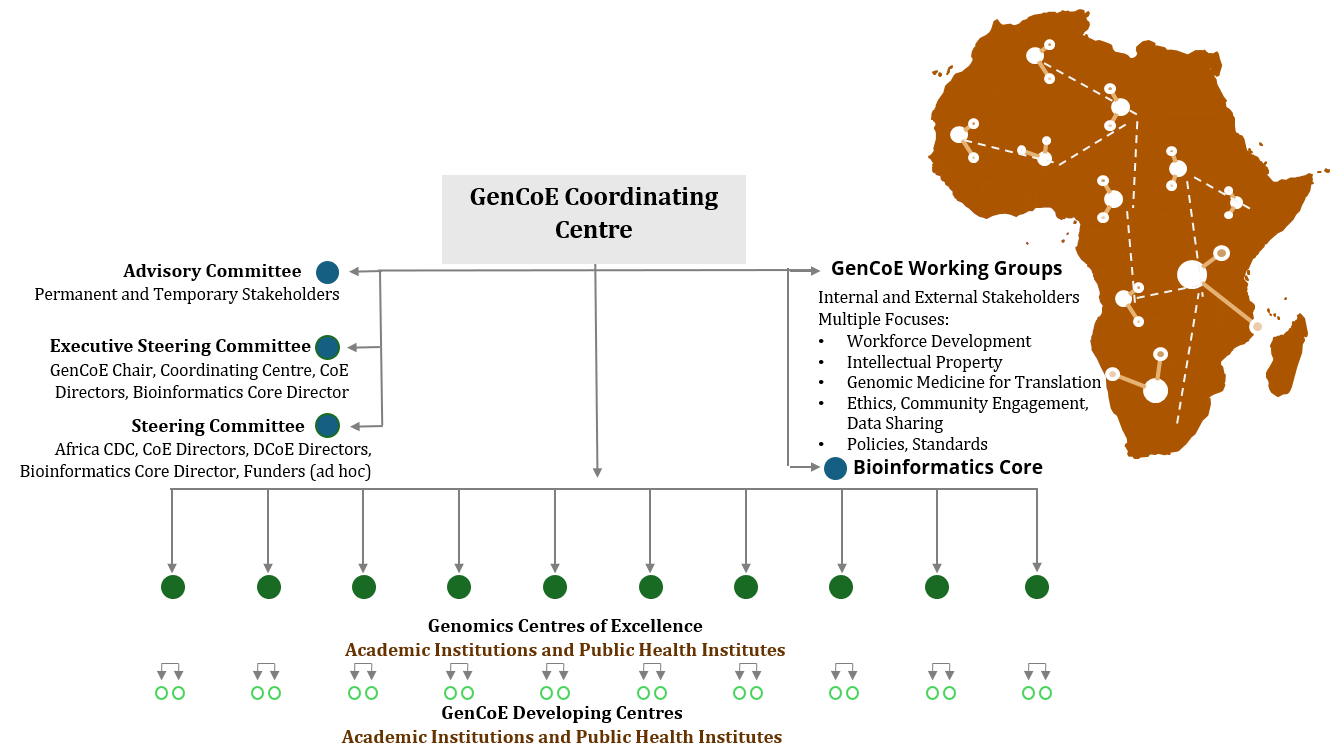
Governance Structure
Advisory Committee
Permanent and Temporary Stakeholders
Executive Steering Committee
GenCoE Chair, Coordinating Centre, CoE Directors, Bioinformatics Core Director
Steering Committee
Africa CDC, CoE Directors, DCoE Directors, Bioinformatics Core Director, Funders (ad hoc)
GenCoE Working Groups
Internal and External Stakeholders Multiple Focuses:
Workforce Development
Intellectual Property
Genomic Medicine for Translation
Ethics, Community Engagement
Data Sharing
Policies, Standards
Driving African Genomic Excellence
Through strategic coordination, partnership building, and capacity development, the GenCoE Coordinating Centre ensures that genomic research benefits all African populations while contributing to global health advances. Our position in Kigali, Rwanda enables direct collaboration with government partners and regional health authorities to translate research into policy and practice.